


Amazon Review 2025: Associates Pros, Cons, Rates, Payouts
Thinking about turning your product reviews into a way to make money? As a primary tool in affiliate marketing, Amazon Associates lets you earn a cut when someone buys through your link. It is simple to start, and the catalog is huge, which is why so many creators try it. The real question, is it still worth your effort in 2025?
Here are the basics you should know before you dive in. Current rates range from 0% to 10%, based on category. Luxury beauty pays up to 10%. Digital music and video pay around 5%. Many common items sit near 1 to 4.5%. Gift cards pay 0%. Payments hit about 60 days after the month closes, and you can get paid by direct deposit, check, or Amazon gift card.
The Amazon affiliate program updated policies on October 15, 2025, with tighter rules on link formats and content. That matters if you share short links, screenshots, or price mentions. I have seen creators miss out because of small mistakes. You should not.
What you will get here:
- Clear pros and cons, with no fluff.
- Simple math to size your earnings, plus quick use cases.
- Practical tips to avoid common compliance mistakes.
If you want a realistic take, you are in the right place. You will leave knowing where this program fits, and where it falls short.
How Amazon Associates Works in 2025
Here is how the program actually runs day to day. You apply, get your account approved, and start using Amazon’s link tools. When people click your link and buy eligible products, you earn based on the item category. Payments arrive on a delay, and you do need to follow policy updates. That is the simple version, and it still holds in 2025.
Sign Up, Get Approved, and Set Up Your Account
Getting started is straightforward if you prepare your site and profiles first for the sign up process.
- Add your website, app, or social channels in the application. Share what you cover, your audience, and the types of products you plan to feature.
- Add a clear affiliate disclosure in visible spots. For example: As an Amazon Associate, I earn from qualifying purchases.
- Create tracking IDs to organize your traffic. Keep them short, readable, and tied to sections or themes.
- Explore your dashboard. Find the key areas early:
- Reports for clicks, ordered items, and earnings.
- Fees and commission rates by category.
- Link tools like the SiteStripe tool, product links, and banners.
What I do:
- I create one tracking ID per top page group. It keeps reports clean and makes it easier to audit winners and losers.
Quick setup checklist:
- Publish your disclosure on every page that includes affiliate links.
- Add at least three to five relevant links to your early posts.
- Submit your application with accurate contact details.
- Verify payment and tax sections so approvals and payouts are smooth.
How Links and Tracking Credit Sales
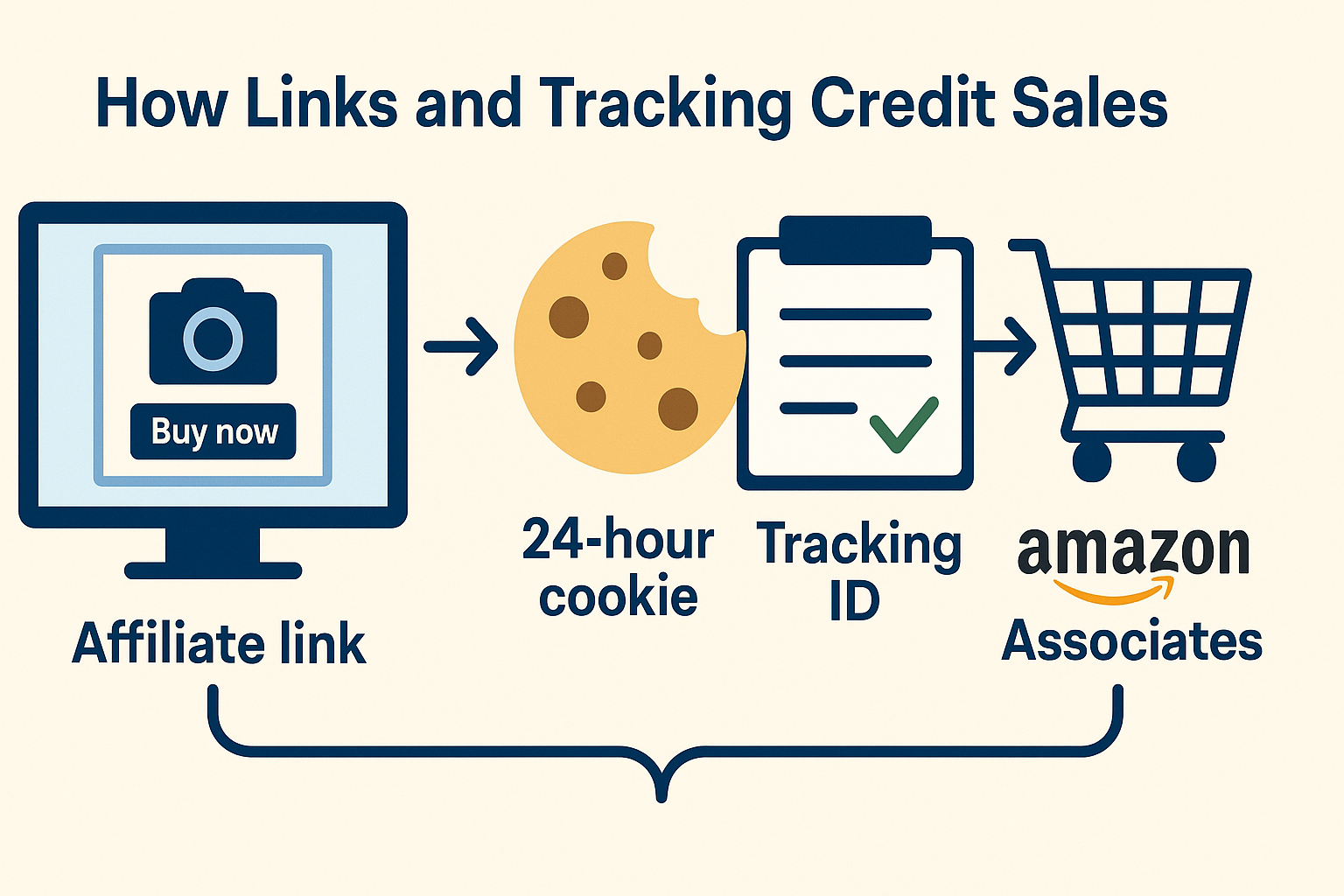
Your affiliate links are the entire system. Get them right.
- You generate special links that include your Associate tag. Amazon ties clicks and orders to that tag.
- If a reader buys any eligible product after clicking your link, you get the category rate for that item, not the rate for the page topic. This happens within the cookie duration, which is standardly a 24-hour cookie that tracks user sessions.
- Use the exact link format Amazon provides. No cloaking that hides the destination. Short links from Amazon are fine; third-party cloakers are not.
- Keep links only on approved channels that you listed and that meet program rules. The cookie duration applies across these channels to ensure proper crediting.
Simple placement tips:
- Put one text link near the top, so scanners see it.
- Place another link near the bottom, after your key takeaways.
- Add a link inside a comparison table, right next to the product name.
- Use clear anchor text. Readers should know what they are clicking.
Troubleshooting ideas:
- Click your own links to confirm they resolve correctly. Do not buy through them.
- Compare your tracking ID in the link against the ID used in reports.
- If a product gets updated or removed, replace that link fast to avoid dead ends.
Payments, Thresholds, and Tax Basics
Earnings do not arrive right away. Expect a delay.
- Payouts land about 60 days after the month closes.
- Payment methods include direct deposit, check, or an Amazon gift card.
- You must meet a minimum threshold to get paid. This number can vary by method and region.
- You will provide tax information during setup. Keep records and download monthly reports for your accountant.
Quick example:
- You earn 150 dollars in January. You should see that payment near late March, as long as you pass the minimum and your payment details are verified.
Practical tips:
- Choose direct deposit if it is available. It is the fastest in my experience.
- Set a monthly reminder to reconcile reports against your CMS analytics.
- Track refunds. Returns can reduce earnings in later reports.
Policy Notes You Should Watch in 2025
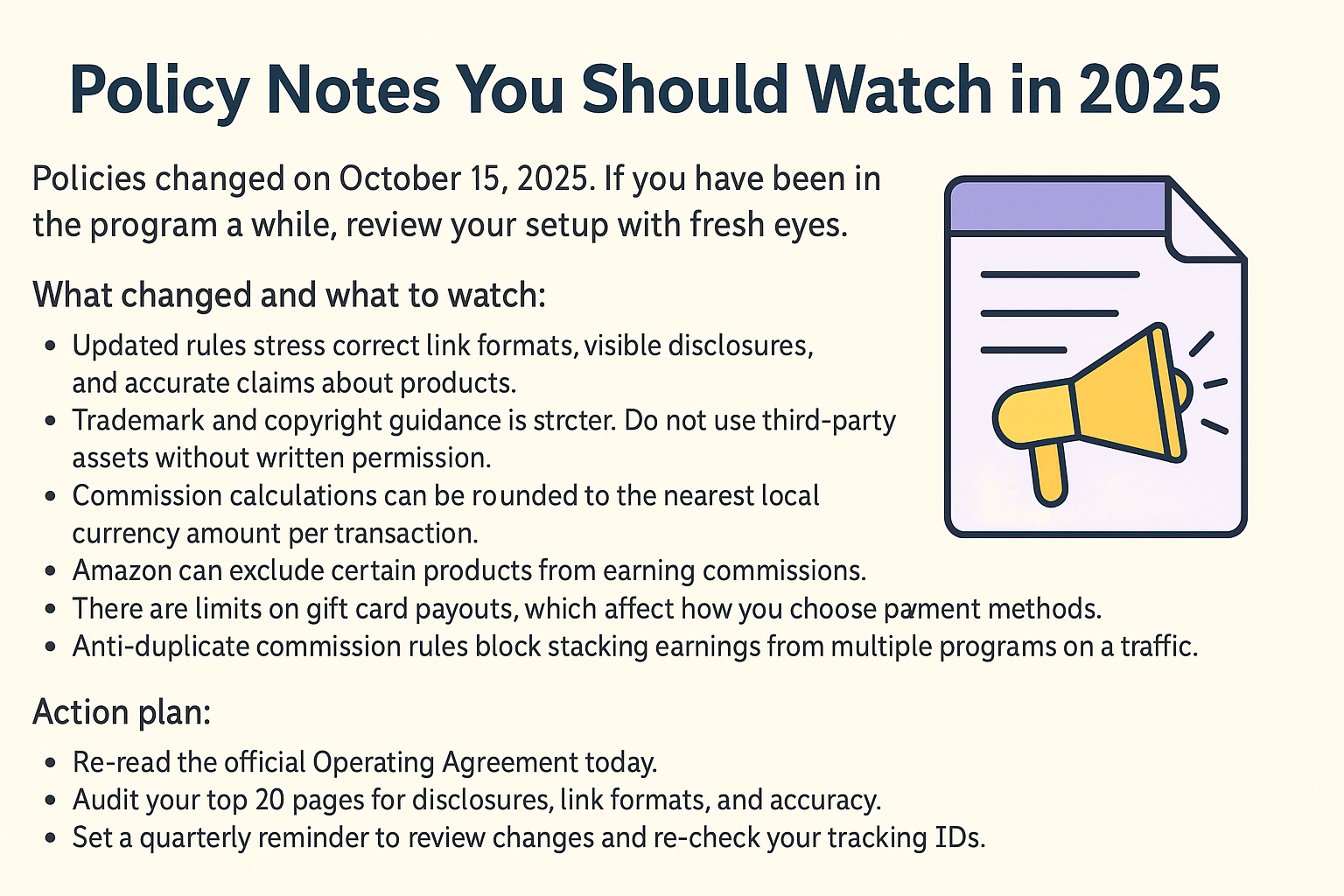
Policies changed on October 15, 2025. If you have been in the program a while, review your setup with fresh eyes.
What changed and what to watch:
- Updated rules stress correct link formats, visible disclosures, and accurate claims about products.
- Trademark and copyright guidance is stricter. Do not use third-party assets without written permission.
- Commission calculations can be rounded to the nearest local currency amount per transaction.
- Amazon can exclude certain products from earning commissions.
- There are limits on gift card payouts, which can affect how you choose payment methods.
- Anti-duplicate commission rules block stacking earnings from multiple programs on the same traffic.
Why this matters:
- Breaking rules can lead to withheld earnings or account removal. I have seen accounts lose months of income over missing disclosures or link masking.
Action plan:
- Re-read the official Operating Agreement today.
- Audit your top 20 pages for disclosures, link formats, and accuracy.
- Set a quarterly reminder to review changes and re-check your tracking IDs.
- Keep a simple compliance doc with what you changed and when. It helps if you ever need to appeal.
Pros That Make Amazon Associates Attractive
Amazon Associates shines for creators who want a simple, trusted way to monetize content via affiliate marketing. You get a massive product pool, quick setup, and reports that make sense. It is not perfect, but these pros keep it on my shortlist for most sites.
Huge Catalog and Trust That Helps Convert
Selection matters because your readers have specific needs. Amazon carries millions of products, which means you can almost always find a solid match for your topic.
- Massive choice: Niche parts, everyday items, and seasonal picks are all in one place.
- Trusted checkout: People know Amazon as a trusted brand, so they hesitate less and buy faster.
- Basket boost: Readers often add extra items after clicking your link. You earn on the eligible items in the cart, not just the one you recommended, leading to more qualified sales.
Why this helps you:
- You can cover more keywords with relevant picks.
- You do not need to juggle multiple affiliate accounts for common products.
- The same link can convert across different audiences, which simplifies testing.
Quick example:
- A back-to-school list links to notebooks and backpacks. Readers also buy pens and storage boxes.
- A coffee gear post links to a grinder. Some buyers add beans and filters.
- A home gym guide links to dumbbells. Shoppers throw in a mat and a jump rope.
Easy Setup and Flexible Links Across Platforms
You can share links wherever your audience hangs out. That makes it simple to test ideas and double down on channels that click.
- Flexible placement: Add links on blogs, YouTube descriptions, newsletters, and social posts that meet program rules.
- Influencer Program: Social-first creators can build a simple Amazon storefront via Creator Connections. It is handy for TikTok, Instagram, and Shorts, where people ask, “Where can I get it?”
- Simple link tools: SiteStripe and the product link tool make affiliate links in minutes.
Practical tips:
- Use clear anchor text. Tell people what the product is and why it helps.
- Keep one tracking ID per content group. It keeps reporting clean.
- Test one hero product per page instead of overwhelming readers with ten options.
Personal note:
- I tested one product box plus one text link above the fold. Clicks went up.
What to try next:
- Add a single top-pick box at the start of your article.
- Place a second text link after your key takeaway.
- Review clicks after one week, then adjust placement.
Reliable Payouts and Clear Reporting
Payments are steady, which helps with planning. The reports are plain and useful.
- Predictable payouts: Payments usually arrive about 60 days after the month closes.
- Useful metrics: See clicks, ordered items, shipped items, conversion rate, and earnings.
- Granular tracking: Track by page or by tracking ID to spot winners.
How to use the data:
- Find pages with clicks but low orders: Tighten product-market fit or improve your call to action.
- Spot high AOV items: Push them higher on the page to capture more earnings per click.
- Compare IDs: If “guide-top” outperforms “guide-bottom,” move your main link higher.
Simple routine:
- Check daily clicks and ordered items.
- Tag any page with a drop in conversion.
- Update links or product choices within 48 hours.
Good for Beginners and Mixed Niches
You can start small and grow as you learn. It fits many formats without a complex setup.
- Beginner-friendly: Low friction to join and link. You can launch with a few posts.
- Content fit: Works for gift guides, review posts, listicles, and how-to content.
- Seasonal spikes: Q4 and big events like Prime Day can lift earnings. Plan content ahead of those windows.
Starter playbook:
- Pick three evergreen posts and add a clear top-pick link.
- Build one seasonal page, like a holiday gift guide or back-to-school list.
- Refresh links monthly to replace out-of-stock items.
Ideas that usually perform:
- “Best under 50 dollars” lists for quick buys.
- One-page starter kits for hobbies and DIY.
- Product comparisons with a single clear winner.
Prompt for you:
- List three pages where a simple product link would help. Add one text link near the top, then one near the end. Track clicks for a week and note what changes.
Cons and Limits You Should Know Before You Dive In
Amazon Associates is part of the broader affiliate marketing space, which comes with its share of limitations. Margins are thin in many categories, policies are strict, and payouts take time. If you plan content and expectations with these limits in mind, you will avoid most headaches.
Low Rates in Common Categories
Many physical items earn commissions of around 1 to 4.5%. That is fine for volume sites, but it can feel slow if you are just starting.
- Low rates on everyday items mean you need steady traffic to see meaningful income.
- If your audience buys small-ticket products, earnings will lag.
- A single sale often pays cents, not dollars.
What moves the needle:
- Aim for higher AOV items. Think specialty gear, bundles, or full kits.
- Pick better categories when they fit your niche. Some segments pay more than others.
- Stack value with comparison tables and one clear top pick. Better conversions help offset low rates.
Quick math:
- At 3%, a $50 item pays $1.50. You need 67 orders to reach 100 dollars.
- At 3%, a $300 item pays $9. Only 12 orders reach 100 dollars.
Ask yourself: do your top pages naturally support higher-price picks? If not, can you add one premium option without forcing it?
Strict Rules and Risk of Account Removal
Amazon’s rules, as enforced by the official Operating Agreement, are not flexible. Break them and you can lose commissions or your account.
Key risks:
- Link format must be exact. Your tag has to show in the URL. No hidden or cloaked affiliate links.
- A clear affiliate disclosure on pages and profiles is required. Place it before or near the first link.
- No misleading claims. Avoid fake reviews, unverifiable results, and medical claims.
- No static prices unless pulled from approved APIs. Prices change, and stale numbers cause issues.
Simple compliance checklist:
- Disclosure is visible on every page with affiliate links.
- Links created with SiteStripe or the official tools, tag confirmed.
- No copied reviews or manufacturer content without permission.
- No images or logos that you do not have the right to use.
- Social bios and video descriptions include your disclosure.
- Price mentions removed or automated with approved tools.
Routine that works:
- Review your top 20 pages monthly. Click links, check disclosures, update screenshots, and replace out-of-stock items.
- Keep a one-page log of changes. If something goes wrong, you have a record.
Payout Delay and Minimum Threshold
Earnings do not post right after a click. They finalize after orders ship and the return window closes. The payment you see hits about 60 days after the month ends.
What that means:
- January earnings get paid late March, if you meet the minimum and your details are verified.
- Minimum thresholds apply. Small sites may wait longer if they do not hit the payout floor.
- Returns and cancellations reduce later statements, so totals can shift.
Plan cash flow:
- Expect a two to three-month gap between content wins and money in your account.
- Choose direct deposit if available for faster access.
- Track monthly earnings in a simple sheet to forecast.
Do this now:
- Open your calendar and map payouts for the next 3 months. Mark when each month’s earnings should arrive, based on the 60-day delay and your threshold.
Zero Commission Items That Surprise You
Some items pay 0%, which can kill a page’s revenue without you noticing. Unlike some other affiliate programs that offer commissions across all products, Amazon has these surprises.
Common gotchas:
- Gift cards pay 0%.
- Certain subscriptions and service sign-ups pay 0% by commission. Some have separate bounty offers, which are different.
- Categories get updated. A product that paid last quarter might not pay now.
How to avoid dead ends:
- Check the current fee schedule before planning a content series or a holiday guide.
- Swap links to similar items that are eligible. If the main pick pays 0%, link to a comparable model that earns commission.
- Suggest bundles that include eligible products. For example, instead of a gift card, suggest a “starter kit” with a guidebook, case, and accessory.
Example move:
- If a streaming subscription pays 0% by commission, highlight a compatible device or accessory that earns a percentage. You still solve the reader’s problem and keep the page profitable.
Bottom line, before you publish a new roundup, run a quick rate check. A five-minute review can save weeks of missed earnings.
Commission Rates in 2025 and What They Mean for You
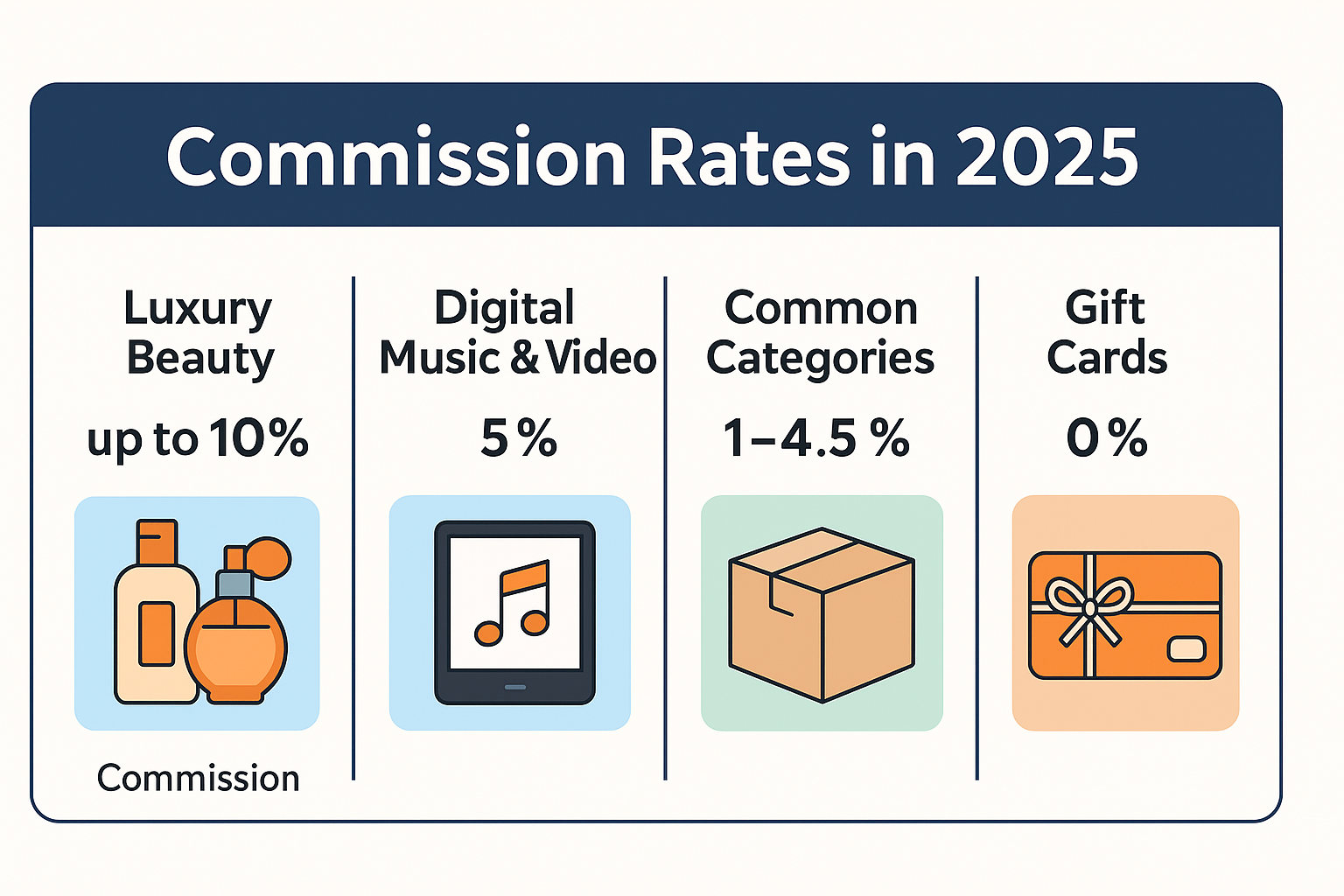
The commission rates of Amazon Associates decide how hard your content has to work. In 2025, most physical items pay 1 to 4.5 percent, while a few categories sit higher. Luxury beauty reaches up to 10 percent. Digital music and video are at nearly 5 percent. A handful of outliers, like Amazon Games, pay a lot more, but they are niche. Your plan should match rate, price, and buyer intent. That mix shapes your earnings, not just traffic.
Higher-Rate Categories You Can Target
You do not need to change your niche to find better payouts. You can layer smart angles into what you already cover.
- Luxury beauty at up to 10 percent:
- Think premium skincare, fragrance, and giftable sets.
- Create “starter routines,” “travel kits,” and “under 100 dollars” picks.
- Feature bundles and limited editions, since AOV tends to rise.
- Digital products like music and video are at about 5 percent:
- Focus on playlists, soundtrack tie-ins, and curated collections.
- Pair content with compatible gear that pays a percentage.
- Hook interest with “music for focus,” “party mixes,” or “teacher playlists.”
- Practical content ideas that fit high rates:
- Gift guides for birthdays, graduations, and holidays.
- “Best luxury dupes” versus “true premium” side by side.
- “Playlist plus item” posts, like a jazz playlist with a turntable and sleeves.
Questions for you:
- Which two topics can you publish that include luxury beauty sets or digital media bundles?
- Where can you add a premium pick without forcing it?
Common Low-Rate Categories and How to Handle Them
Most everyday goods pay between 1 and 4.5 percent. That stings if your prices are low or your pages scatter attention. You can still make it work with structure.
- Pair low-rate items with helpful bundles:
- Turn single picks into “complete kits” that raise order value.
- Example: “Beginner baking kit” with a pan, thermometer, liners, and a spatula.
- Use comparison guides to speed decisions:
- Simple tables and one clear winner reduce choice overload.
- Readers buy when they trust the pick, not when they see ten equal options.
- Push value and clarity:
- Explain who each item is for, and who should skip it.
- Add one paragraph on trade-offs. People appreciate straight talk.
- Practical moves:
- Lead with one recommended pick, then offer one budget and one upgrade.
- Remove items that cause indecision. Fewer, better choices convert.
- If an item pays 1 percent, add one accessory or add-on that pays more.
Content Ideas That Match Rates and Buyer Intent
Match format to how people buy. Quick decisions need clear picks. Higher spending needs trust and proof. These ideas also improve SEO performance by targeting relevant search terms and user intent.
- Best-of lists for every budget:
- Examples: “Best under 50 dollars,” “Best mid-range,” “Best premium.”
- Add a short reason under each pick, not a wall of text.
- Short reviews with pros, cons, and who it is for:
- Keep it tight: 3 pros, 2 cons, and a one-line verdict.
- Add a quick “Buy if” and “Skip if” to anchor the decision.
- Simple comparison tables:
- Columns: Model, Price range, Key feature, Best for, Link.
- Keep it scannable. Two to five rows are enough for most pages.
- Seasonal guides:
- Holiday gifting, back-to-school, graduation, Mother’s Day, Father’s Day.
- Tie luxury beauty to gifting seasons and digital media to events or parties.
- Quick examples:
- “Luxury skincare gift sets under 150 dollars” with a 10 percent rate focus.
- “Best study playlists plus budget headphones” for back-to-school.
- “At-home spa night kit” that bundles mask, candles, and a robe.
Quick Math To Set Realistic Goals
Use simple math to sanity-check your plan. Here are two short scenarios that show how rates and order value change outcomes.
- Scenario A, low-rate items:
- 10,000 pageviews, 3 percent click rate, 8 percent conversion, 50 dollars average order value, 3 percent commission.
- Clicks: 300. Orders: 24. Commissions: about 36 dollars.
- Scenario B, higher-rate items:
- 8,000 pageviews, 4 percent click rate, 8 percent conversion, 120 dollars average order value, 10 percent commission.
- Clicks: 320. Orders: 26. Commissions: about 312 dollars.
Quick view:
| Scenario | Pageviews | Click Rate | Clicks | Conversion | Orders | AOV | Commission | Estimated Revenue |
|---|---|---|---|---|---|---|---|---|
| Low-rate | 10,000 | 3% | 300 | 8% | 24 | $50 | 3% | ~$36 |
| High-rate | 8,000 | 4% | 320 | 8% | 26 | $120 | 10% | ~$312 |
Takeaway:
- Rate and order value shape results. Traffic helps, but content focus matters more.
- If you cannot raise the rate, raise the AOV or the conversion. Even small lifts add up. This strategy is essential for successful affiliate marketing.
Who Should Use Amazon Associates and Who Should Skip It
The Amazon affiliate program works best when your content drives product research and buyer intent. It is easy to start, links are simple to add, and the catalog covers almost everything. Some niches earn better than others. Some business models do not fit. Use this section to decide where you stand and what to try first.
Best Fit Scenarios
If you check a few of these boxes, you are in a good spot.
- Sites with steady product research traffic:
- Comparison guides, reviews, and “best-of” pages that attract buyers.
- Evergreen topics that keep clicks and orders coming each month.
- Search queries with “best,” “vs,” and “review” in the title.
- Creators in beauty, home, and media where rates are stronger:
- Luxury beauty products can reach higher commission rates.
- Digital and physical media often sit near mid-range rates and convert well.
- Home categories are broad, so you can fill many content gaps.
- Mixed-niche sites that need a wide store and easy links:
- General lifestyle blogs, hobby sites, and family guides that cover many categories.
- Stores with a lot of alternatives when the first pick is out of stock.
- Teams that want one source for product images, specs, and links.
Quick prompt to act on now:
- Open your analytics and list your top three pages with buying intent.
- Match each page to one main Amazon product plus one backup.
- Add one clear text link above the fold on each page today.
When Another Network Might Pay Better
There are real trade-offs. If you have access to higher rates or bigger payouts, test them.
- Brands with private programs often pay more and lead to more qualified sales:
- Many direct affiliate programs offer 10 to 20 percent or tiered bumps.
- Niche brands may also provide exclusive coupons that lift conversions.
- Software, courses, or high-ticket gear can pay far more elsewhere:
- Recurring SaaS plans, premium courses, and pro equipment can pay higher fixed or percentage rates.
- Even a few sales can beat a month of low-rate physical items.
- If you can build direct brand deals, you may earn more per sale:
- Hybrid deals that mix affiliate links with flat fees or bonuses.
- Co-branded content, email features, and bundles that raise order value.
Practical tip:
- Keep Amazon as a fallback link for fast shipping and a wide selection. Use it when the private program is out of stock, geo-restricted, or slow to convert.
Quick Niche Snapshots
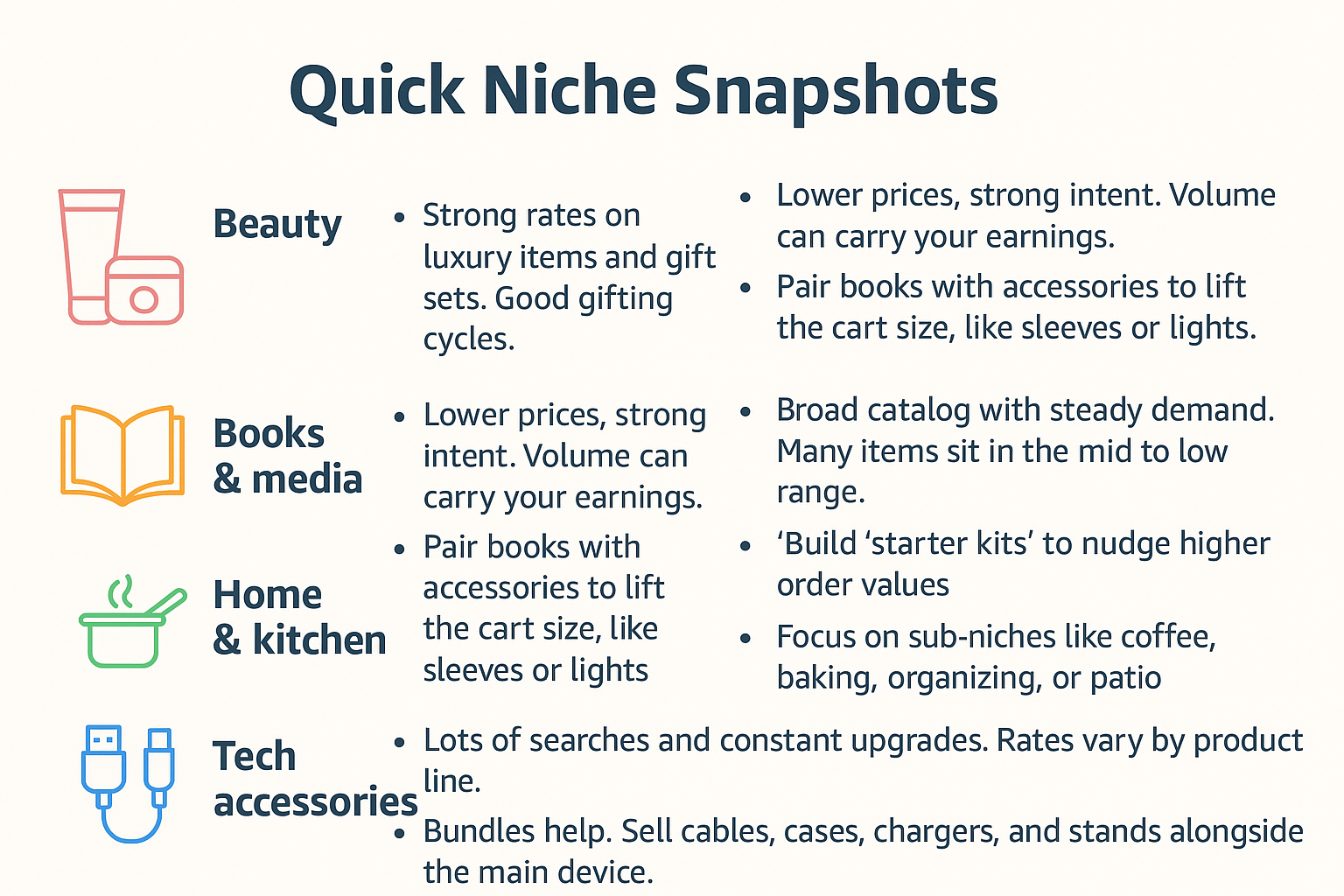
To succeed in these niches, high-quality content writers are important for crafting engaging material. Here is a fast way to gauge fit before you invest time.
- Beauty:
- Strong rates on luxury items and gift sets. Good gifting cycles.
- High competition, so you need specific angles like “oily skin routine” or “travel kits.”
- Short, photo-rich reviews and simple routines tend to convert.
- Books and media:
- Lower prices, strong intent. Volume can carry your earnings.
- Pair books with accessories to lift the cart size, like sleeves or lights.
- Curate lists by goal, not genre. “Learn Python in 30 days,” “Summer beach reads.”
- Home and kitchen:
- Broad catalog with steady demand. Many items sit in the mid to low range.
- Build “starter kits” to nudge higher-order values.
- Focus on sub-niches like coffee, baking, organizing, or patio.
- Tech accessories:
- Lots of searches and constant upgrades. Rates vary by product line.
- Bundles help. Sell cables, cases, chargers, and stands alongside the main device.
- Keep content fresh. New versions and specs shift buyer choices fast.
Example page ideas:
- “At-home espresso starter kit” with grinder, scale, and tamper.
- “Back-to-school reading list” plus lamps and bookmarks.
- “iPad travel setup” with case, keyboard, and power bank.
A Short Personal Take
I once moved three top posts from general home items to luxury beauty sets and mid-range kitchen gear using strategies common in affiliate marketing. Same traffic, tighter picks, clearer intent. Earnings lifted about 2.3x in six weeks. Not magic. Just a better category fit and a higher average order value.
On the flip side, a small policy hiccup cost me a month of payouts. I had two old posts with missing disclosures and one price mention that was not pulled from an approved source. It stung. I built a simple checklist after that: disclosure near the first link, link format confirmed, no static prices, and a monthly top-20 audit. I still miss things sometimes, but the checklist saves me from expensive mistakes.
Practical Tips To Earn More and Stay Compliant
You do not need tricks. You need a clean setup, solid content, and a routine you can repeat. These moves help you earn more from Amazon Associates while staying on the safe side of policy updates.
On-Page Tactics That Move the Needle
These tactics improve SEO performance and help pages rank in Google, while putting value first and making it easy to click. Keep the page light and fast.
- CTA near the top: [See it on Amazon]
- One image with alt text
What to do on every money page:
- Answer the main question in the first 3 to 4 lines.
- Use short bullets for pros and cons. No walls of text.
- Put one link near the top and one near the end.
- Avoid static prices. Link to the product page for current details.
- Keep images small in file size. One image is enough on fast pages.
Quick setup checklist:
- Add a short benefit line above the fold. One sentence.
- Use scannable subheads like “Who it is for” and “What to know.”
- Place your first link after the first paragraph. Your second link after the verdict.
- Use clear anchor text. Example: “See current options on Amazon.”
- For easy implementation, consider using a CMS like WordPress.
Near the end, add a second CTA:
- CTA near the end: [Check availability on Amazon]
Content Formats That Convert
People decide faster when the format does the heavy lifting, especially with a solid content structure. Keep choices tight and the verdict clear.
Short reviews that work:
- Who it is for, 1 to 2 lines
- 3 pros, 2 cons
- One-line verdict with a single product link
- Example flow:
- Pros: solid battery life, clear sound, lightweight
- Cons: limited color options, case feels thin
- Verdict: A safe mid-range pick for commuters. [See details on Amazon]
A vs. B comparisons:
- Open with the quick winner and why.
- List 3 reasons it wins. Keep it blunt.
- Link to both, but put the winner first.
- Example: “Winner: Model A for battery life and app support. Model B only if you need ANC at a lower price.”
Best-of lists, three to five picks:
- One top pick, one budget, one upgrade. Add two alternates if you must.
- Each pick gets a single benefit line and a link.
- Remove weak picks that slow decisions.
Seasonal gift guides:
- Group by use case and budget brackets. Keep it simple.
- Use headers like “Gifts for travelers” or “For new parents.”
- Add one line per pick on who should buy it.
- Link to the product page, not prices.
Compliance Checklist for 2025
Policies changed after October 15, 2025, with stricter rules on claims, link format, and excluded products. Keep your pages clean and your account safe. Correct methods are necessary for Amazon link creation, and commissions may be rounded per transaction in your local currency.
- Use Amazon’s special link format with your Associate tag visible, confirming the use of the SiteStripe tool.
- Place the required disclosure near the top of posts and in social bios.
- Do not say you are endorsed by Amazon or affiliated in a special way.
- Keep content accurate. No false or unverifiable claims.
- Avoid static prices unless pulled from approved tools.
- Respect copyright. Do not use third-party images or assets without written permission.
- Some items are excluded and pay zero. Check the current fee schedule and ensure commission rates are checked.
- Be aware of the 24-hour cookie for the tracking window.
- Gift card payout limits exist. Know your region’s cap.
- Re-check any policy changes after October 15, 2025, and quarterly after that.
Ongoing habits:
- Review top-earning pages monthly. Confirm disclosures, link formats, and eligibility.
- Make a quick note: what you checked, what you fixed, and when.
Simple Workflow To Track and Improve
Run a tight weekly loop. It takes 30 minutes if you focus.
- Check clicks, ordered items, and earnings by tracking ID. Note the top and bottom two.
- Open your top posts. Add one clearer CTA or one more contextual link.
- Remove dead affiliate links. Swap out-of-stock picks for in-stock alternatives.
- Compare conversion rates week over week. If clicks rise but orders lag, swap the hero pick.
- Test one new angle next week. Example: move the top pick above the first subhead, or tighten the intro to two lines. Compare results.
Personal tip:
- I keep a small spreadsheet. Date, page, tracking ID, clicks, orders, earnings, and the change I made. It keeps me honest and focused.
Conclusion
Amazon Associates is simple to start, stable to run, and it pays on time. Rates range from 0% to 10%, and many everyday items sit near the low end. You win when you feature categories with better rates or raise cart size with kits and add-ons. Pick one clear top pick, keep links clean, and follow the rules on disclosures and link formats. It is not flashy, but it is steady, and that predictability helps you plan.
I keep coming back to two levers: higher AOV and category fit. A small shift can move results fast. One page tweak, then another. You will see it in the reports from this successful affiliate marketing approach.
Try this this week:
- Pick two categories that fit your site, one higher rate and one mid-rate.
- Draft one new review and one comparison. Keep verdicts short and direct.
- Add clear disclosures near the top. Watch clicks, orders, and earnings for 30 days.
What would change if your top page pushed one premium pick first? For those looking to build a website that can make money over time, test, learn, and adjust. Join me at Wealthy Affiliate below and learn how to write reviews and articles like this that can rank and reach eyes like yours!