
Myths About AI Debunked
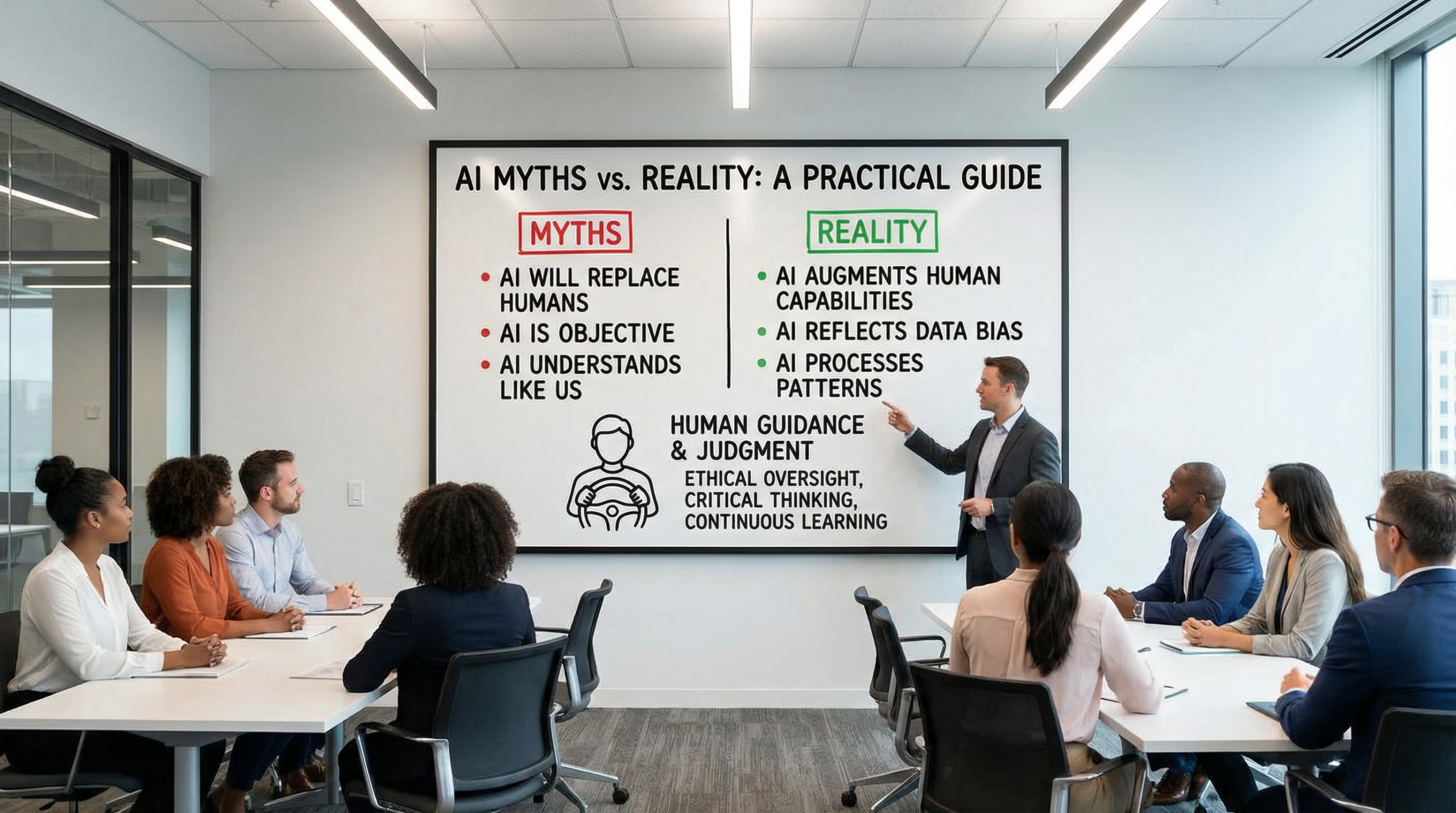
People hear a lot of outrageous claims about AI taking over jobs. It makes AI sound like a giant machine rolling toward every workplace. The truth is less dramatic. AI helps with dull tasks, saves time, and supports people doing real work. It gives space for skills that matter, not less.
AI is neither the devil nor the angel. It’s a tool. Its impact depends on how we choose to use it.
Fei-Fei Li, co-director of Stanford’s Human-Centered AI Institute, and former Chief Scientist of AI at Google Cloud
You see this in the real world. Nurses get more time with patients because software handles data processing. Support teams handle fewer routine questions because chatbots handle the simple ones. Jobs shift, yes. But new roles appear. People who learn to work with AI gain more control, not less.
There are real concerns in the job market. Some tasks change. Some work will fade. But new skills rise with it. Data work, AI oversight, and roles that bring human judgment into tech now matter more than ever. The future favors people who stay curious, try new tools, and grow their skill set. AI does not replace that effort. It amplifies it.
Humans still hold the parts that count. AI can scan data and find patterns. It cannot feel pride, fear, or joy. It cannot guide a team or handle a tense moment. It cannot read a mood or choose a path based on care. People keep those strengths. AI handles the heavy math so you can focus on human work that needs thought, empathy, and choice.
Myth 2: AI Can Think and Feel Like Humans
Movies love showing robots with dreams and deep hearts. Real AI does none of that. It works on rules, training, and math. It spots shapes in data and gives likely answers. It does not feel anything. It does not reflect on life. It does not worry about mistakes.
Neural networks look fancy, but they are tools. They follow patterns. They produce guesses. They do not understand the moment the way people do. Your assistant may sound friendly, but it is not reading your mood. It is matching words to a learned line.
AI will grow stronger in its skills, but not in its emotions. It helps with speed and scale, not with human meaning. That gap keeps people in control.
Myth 3: Everyday AI Is Too Complex for the Average Person
A lot of people think AI is a wall of strange terms. But most folks use AI every day without effort. Your phone’s assistant, your map app, and your streaming picks all run on simple forms of AI you already understand.
Learning the basics is enough. You do not need deep tech training. Start with words like “algorithm” or “machine learning.” Watch how they show up in the tools you use. Once you see how it works, the fear fades.
Some parts of AI bring real questions. Data safety matters. Choices about privacy matter. But understanding the basics gives you control. You can change settings. You can choose what to use. You can shape your own path with the tech.
The future belongs to people who stay open to learning. Not only experts. Anyone who builds small skills over time can take part in what comes next. AI works best when people guide it with clear goals and strong human judgment.
Key Takeaway
AI is not a job-stealing monster. It is a tool that handles dull, repeatable tasks.
You stay in charge when you learn the basics, keep your data choices in mind, and use AI to support your work, not replace your skills.
The win for non-tech users: you do not need to be an expert. You just need to stay curious and keep testing simple tools that help you do more of the work that matters.
Start Your Online Journey the Simple Way
If you want to learn how to build a real online business without feeling lost or buried in tech, Wealthy Affiliate gives you clear steps, helpful tools, and support from people who have been there. No rush. No pressure. Take a look and see if it fits your goals.
Check Out Wealthy AffiliateA calm start is often the best start.